

Somewhere, right now, someone is typing a prompt into a music generation tool and getting back a finished song in forty seconds.
Decent melody, reasonable lyrics, production that would have cost studio time two years ago.
Clean, professional, and empty.
The tool works, that’s not the argument.
The argument is the question nobody seems to be asking before they open the app is why were you making music in the first place?
It serves it efficiently, and without the inconvenience of needing to feel anything.
But if that was always the reason, then what you were doing was never really music, it was content shaped like music, and AI is just faster content.
There is another answer to why people make music.
It has nothing to do with output.
The human body is approximately 70% water.
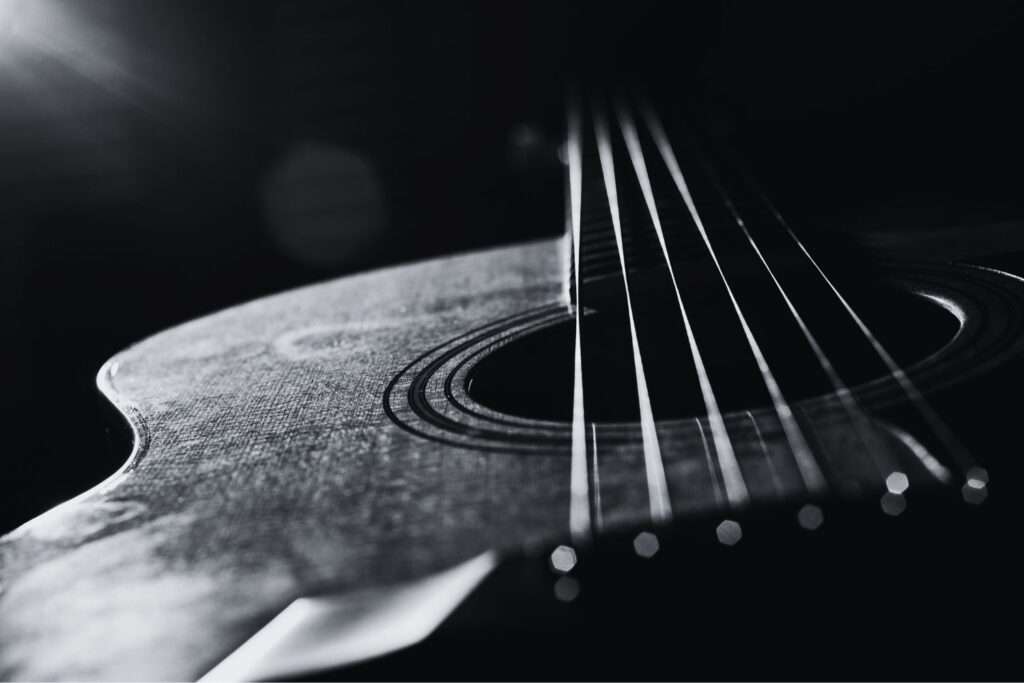
A guitar string vibrates at a frequency that travels not just through air but through whatever is holding the instrument: through hands, through chest, through the floor you are sitting on.
Before any sound reaches another person, it has already moved through you.
That is not metaphor, that is physics, and it’s the part that a streaming platform cannot measure and a prompt cannot generate.
When you sit in a corner with an acoustic guitar and try to find the chord that says the thing your mouth refuses to, something specific is happening, you are translating an interior state into vibration.
The process is not efficient, it resists.
The right chord is not the first chord.
The word that fits is not the word you started with.
That resistance is not a problem to be solved, it’s the mechanism.
The difficulty is where the thing gets made, and where you get made along with it.
Tolstoy had a definition of art that made critics uncomfortable: art is the successful transmission of a felt experience from one person to another.
Not technique, beauty, or originality, nut felt experience, transmitted.
By that definition, most of what fills streaming platforms has never been art, regardless of who or what produced it.
And by that same definition, the song you wrote alone at two in the morning that three people have ever heard might be exactly art.
The conversation about AI music tends to ask whether it sounds good enough, whether listeners can tell the difference, or whether it threatens the industry.
These are real questions for people whose livelihood depends on the answers, but underneath them is a prior question that gets almost no attention: what did making music cost you, and was that cost the point?
Because there is a person you cannot reach.
There is a grief that has no clean sentence.
There is a rage, or a tenderness, or a specific quality of light on a specific afternoon that language keeps sliding off.
You pick up the instrument, and you work on it, not to produce a track, but to find out what it is.
Sometimes you find it, and sometimes the process of looking is enough.
The recorded version is almost secondary, it’s evidence that something happened, not the thing itself.
AI can produce the evidence without anything having happened.
That is not a flaw in the technology, it’s a precise description of what the technology is.
The question is what you were looking for when you reached for the instrument, and whether you still remember.