

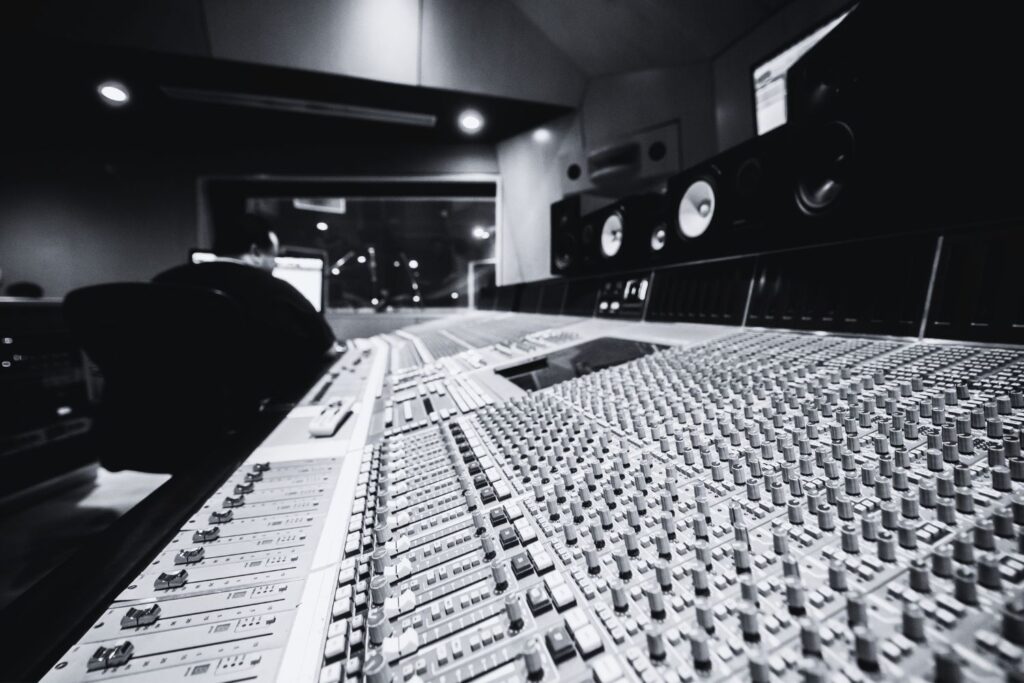
There are musicians who will spend forty minutes repositioning a microphone by two centimeters.
Not because they can’t decide.
Because the sound of a room changes when you move through it, and they know that, and they care about that, and everything in that particular recording depends on whether the early reflections off the back wall arrive at the capsule at three milliseconds or five.
I know because I’ve looked at acoustic panels and then at a bookshelf and thought: those books will absorb differently, depending on their density.
I know because I’ve spent time deciding whether a guitar cable should run parallel or perpendicular to a power cable, and whether the hum that surfaces in a recording is character or contamination.
I know because a room is not neutral, never.
The ceiling height, the carpet, the glass, the furniture, the body temperature of the people in it, all of this arrives, in some form, in the final sound.
Then, someone listens on earbuds while waiting for the 14:42 to Milano Centrale.
I don’t say this with resentment, I say it with curiosity, because that gap is interesting.
Not the gap between effort and reception, that’s old and boring, and every artist has complained about it.
The interesting part is what that listening does, or doesn’t do, to the listener.
There’s a difference between hearing and listening.
You already know this abstractly, you probably don’t feel it concretely.
Hearing is biological, the sound enters, the brain processes, you continue existing.
Listening is something else, it’s directed.
It requires a small act of will, a narrowing of the aperture.
It’s what happens when a sound stops being background and starts being the thing in front of you.
This is identical to the difference between looking and seeing in photography.
A camera pointed at a street produces a document, an eye that has learned to see produces something else.
The difference is not technical, it’s attentional.
The photographer who works slowly is not slower, they’re attending.
To the quality of the shadow, to the negative space between two figures, to the geometry that the rest of us glance past because we’re already looking for the next thing.
Roland Barthes wrote about the punctum, the detail in a photograph that wounds you, that catches and holds, not the obvious subject, not the composition you were meant to see, but the small thing that arrives uninvited.
The cracked shoe.
The particular way a hand rests.
He said you can’t manufacture it, you can only be present enough to notice it when it appears.
Music has a punctum too.
Most people never find it because they’re not listening at that resolution.
They catch the melody, the tempo, the general mood, but they miss the moment the bassist pulls back almost imperceptibly, and the kick drum suddenly has more room.
They miss the breath before the note, they miss the room.
Simone Weil said that attention is a form of love, she meant it morally, but it holds in practice too.
To attend to something is to grant it existence in your perception, to consume it without attending is to use it as furniture.
The musician who spent forty minutes on microphone placement made something that rewards a specific quality of listening.
Both of them trained themselves to notice at a resolution that most people never reach.
Both of them made work that will land differently depending on who receives it.
Whether you’re willing to be that kind of receiver is, in the end, a choice, not a grand one, just the small decision to stop, hold still, and let the thing in front of you be more than it seems.