

There is a particular kind of motivation that arrives fully scored.
You know the moment.
Something shifts, a conversation ends badly, a number on a scale, a photograph of yourself you weren’t expecting to see, and suddenly there is music in your head that wasn’t there before.
You stand somewhere, maybe a bathroom mirror, maybe a parked car, and you feel the sentence forming. Something like: now everything changes.
The feeling is real. The production value is high.
And then, usually within 72 hours, you are exactly where you were.
This is not a character flaw. It is closer to a structural feature of how we are built.
The problem isn’t that you lack willpower. The problem is that you are confusing a weather event with a climate shift.
Motivation is elastic.
It contracts the moment the resistance becomes real, the moment the work stops resembling the montage and starts resembling a Tuesday. What replaces it, if anything does, is something quieter and considerably less cinematic.
Discipline, which is just motivation that has forgotten how to perform. It doesn’t arrive with a soundtrack. It arrives like a habit, which means it barely arrives at all. You just find yourself doing the thing.
But there is a version of this that doesn’t get discussed, which is what happens when you turn that same quality of attention inward. Not toward productivity. Toward the parts of yourself you have arranged your life to not look at directly.
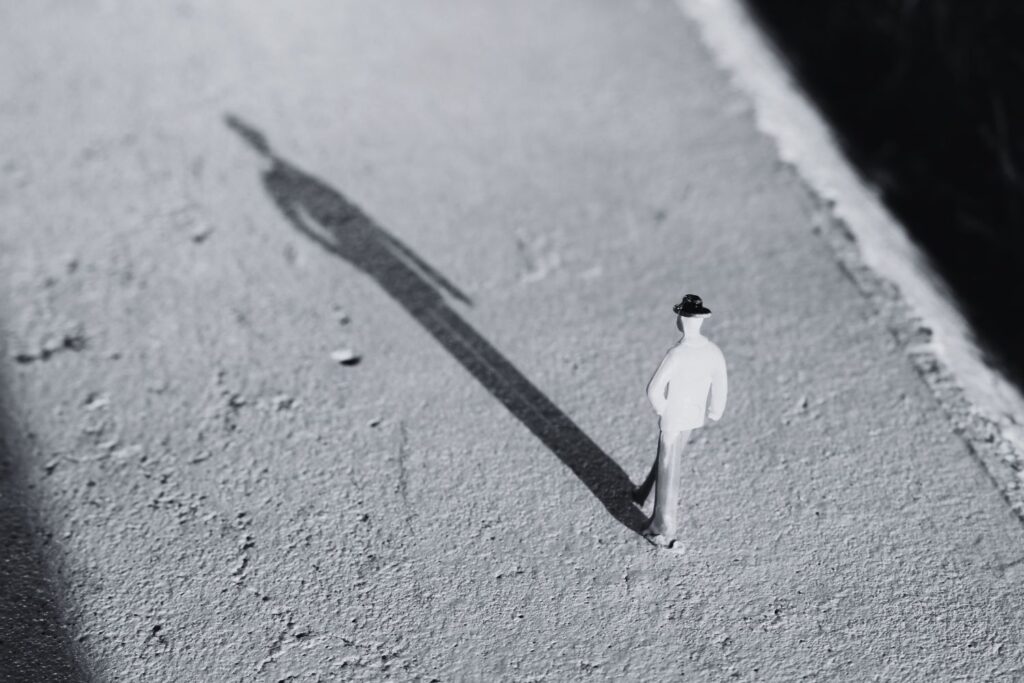
Jung called it the shadow.
Not evil, necessarily. Sometimes it’s just the grief you didn’t finish, the anger you decided was unacceptable, the desire that didn’t fit the role. You push it down with enough consistency and it stops feeling like suppression and starts feeling like personality.
The thing about looking for it is that you can’t approach it the way you approach a productivity goal. There is no system. There is no streak to maintain.
What is required is something more uncomfortable than discipline: it is honesty, and honesty is not the same as confession. Confession is performance.
Honesty is noticing what you actually do when no one is watching, including yourself, especially yourself.
Looking is not seeing.
You can spend a year in therapy, fill journals, read every book in the right section of the bookshop, and still be narrating rather than observing.
The narration is seductive because it has the grammar of insight without the substance. You describe the wound beautifully. You identify the pattern with clinical precision. And then you go home and repeat it.
Seeing requires something the cinematic model of change doesn’t prepare you for: the moment when what you find is not interesting or poetic or useful to your self-concept, but simply true, and unflattering, and yours.
That is when most people look away. And looking away is a choice, which makes it information too.
Here is what you cannot do with information, though. You cannot un-receive it.
Sartre was precise about this: you can act in bad faith, you can pretend the freedom isn’t there, but you already know it is.
The same applies to what you find when you actually look at yourself. You can decide not to act on it. You can return to the performance, pull the mask back on, and re-enter the role.
People do this constantly and with great skill. But somewhere below the performance, the thing you saw is still there, unchanged, patient in the way that only true things are patient.
The question isn’t whether you are ready to change. That’s the movie talking again.
The question is simpler and harder: what are you pretending, right now, that you didn’t already know?
The Last High
Most addiction books want to help you feel understood. This one wants you to feel responsible. The Last High isn't about substance abuse. It's about escape, and the uncomfortable reality that everyone is escaping something. Written from the inside, without sympathy asked or given.