

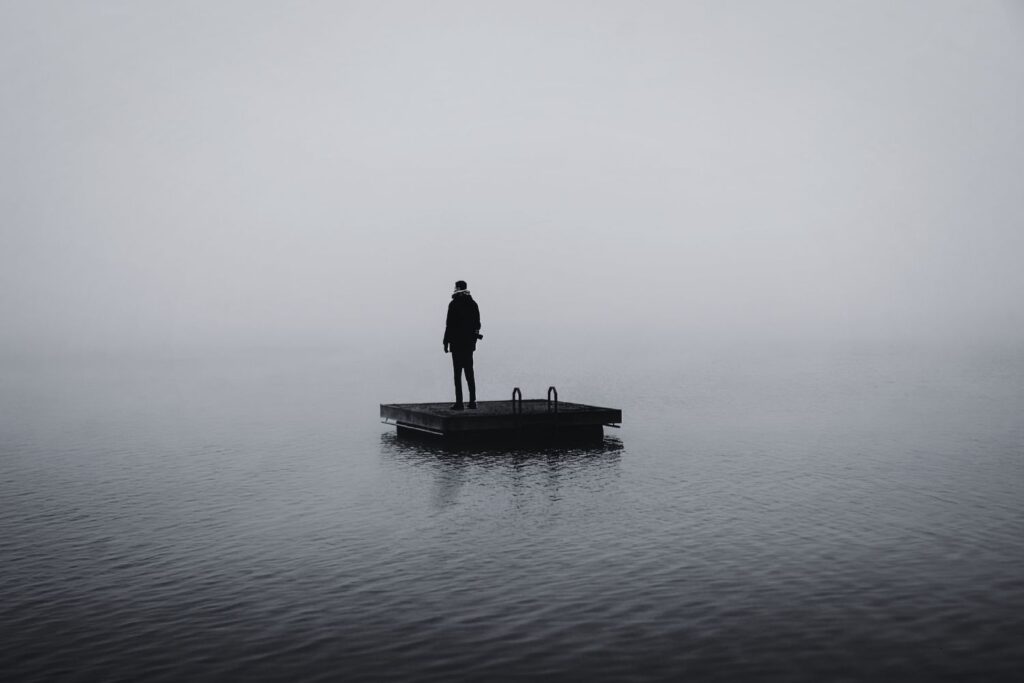
Most people, when they say they need silence, mean they want the neighbors to stop.
They want the group chat to pause. They want the meeting to end.
They are talking about a reduction in volume, not a state change.
This is a reasonable thing to want. It is also the least interesting version of the idea.
Silence, the real kind, is not what’s left when the noise stops. It is something you encounter, not something that happens to you, and most people, if they ever found it, would immediately reach for their phone.
There is a layer of noise that has nothing to do with sound. You can be standing in a forest at four in the morning and still be screaming at yourself.
The continuous internal broadcast, the rehearsal of conversations, the cataloguing of failures, the ambient hum of who you think you are or should be.
This is the layer that the outer noise masks, and masks quite effectively.
The phone, the feed, the meeting, the podcast in the background while you cook: all of it is excellent at keeping you from hearing what’s underneath. Which is, of course, part of the appeal.
Heidegger wrote about attunement, Stimmung, the mood that discloses the world to us before we’ve had a chance to think about it.
You don’t choose your attunement any more than you choose the weather. But you can become aware of it.
Silence is one of the few conditions in which that becomes possible, because it removes the constant override.
When the signal drops, you start to hear the carrier frequency. And the carrier frequency, it turns out, is not particularly flattering.
This is why stillness is not a passive state. It requires a kind of tolerance that most modern life actively trains out of you.
You have been so thoroughly conditioned to fill space, to respond, to produce, to be available, that sitting with nothing in your hands starts to feel like a dereliction of duty.
The guilt of not checking is almost indistinguishable from the fear of what you might notice if you did.
Carl Rogers spent decades insisting that most people do not actually listen, not to others, and certainly not to themselves. What they do instead is evaluate.
They hear a thing and immediately begin sorting it: useful, threatening, flattering, irrelevant. Real listening, the kind he considered genuinely rare, suspends that sorting. It holds what arrives without immediately doing something to it.
This is harder than it sounds, and it is precisely what silence demands of you. Not that you empty yourself, but that you stop processing long enough to simply receive.
There is a particular quality to how a photograph reads when the frame is stripped of everything nonessential. The subject has nowhere to hide. Neither does the photographer.
Subtraction is not a style choice. It is a form of confrontation. What you remove reveals more than what you add. The same logic holds here.
The more faithfully you stay offline, the more precisely you are able to hear the thing that silence actually contains, which is not peace, not immediately, but something closer to the noise you were generating yourself all along.
The signal you were burying. This is not comfortable.
It is, however, considerably more honest than almost anything you will read in two hundred words with a gradient background.
Jung used the word individuation for the lifelong process of becoming distinct from the roles you perform and the projections others place on you.
It doesn’t happen in a workshop.
It happens in accumulated hours of private attention.
The work is not dramatic. It rarely announces itself.
It tends to arrive in the middle of the night, or during a walk with no destination, or in the moment when you’ve finally stopped producing and something older and quieter gets a word in.
You can go deeper into that. You can keep going. There is no floor.
The question is whether you’re willing to stop filling the silence long enough to find out what it was trying to say.
The Last High
Most addiction books want to help you feel understood. This one wants you to feel responsible. The Last High isn't about substance abuse. It's about escape, and the uncomfortable reality that everyone is escaping something. Written from the inside, without sympathy asked or given.