

There are musicians who play everything they know in the first thirty seconds.
Every scale, every fill, every chord they practiced that week.
You can hear the anxiety in it.
The fear that if they stop, even for a beat, the listener will leave.
Most music made today sounds like that fear recorded.
I made that mistake.
My first album, Ready to Go, is electric, loud, layered, guitars stacked on guitars, solos bleeding into each other, drums pushing everything forward before it has time to breathe.
It was fun, it’s an honest one, in its way.
But it’s also a kind of armor.
Fill every gap.
Leave no silence where doubt could sit.
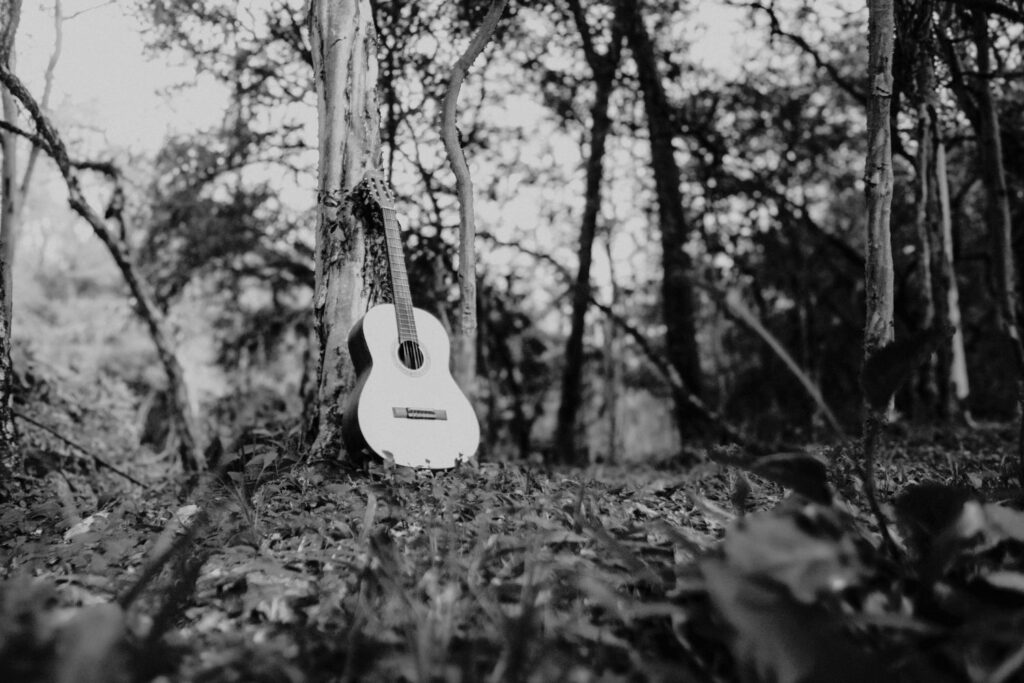
Then the pandemic happened, and suddenly I was alone, in a chair, with an acoustic guitar and the sound of water.
No studio, no layers, no production to hide behind.
I recorded the entire album in one take, on my birthday.
The album became Hotel Rooms.
I didn’t plan the silence.
The silence arrived because there was nothing left to fill it with.
What I discovered, slowly, reluctantly, is that the silence was doing most of the work.
The note you play lands differently when it has space around it.
The chord that follows a pause carries more weight than ten chords played in sequence.
You give the sound somewhere to go.
You give the listener somewhere to feel it.
Miles Davis understood this before most people understood music.
His silences weren’t rests, they were notes.
Held tones of absence that changed the emotional register of everything that came before and after.
The space between his phrases is where the jazz actually lives.
Remove it and you have scales, keep it and you have meaning.
The same principle runs through everything we consider beautifully designed.
Apple’s ads don’t succeed despite their negative space, they succeed because of it.
The emptiness around an object tells you the object matters.
It tells you to look.
When everything competes for attention, the thing that steps back wins the room.
In music, in design, in language, silence is not what happens when you run out of things to say, it is a decision.
It is, in fact, the hardest decision, because it requires trusting that what you already said was enough.
Most musicians don’t trust it.
Most people don’t trust it.
We rush to fill the pause in conversation, we add one more layer to the mix, we post one more thing before the previous one has had time to be seen.
We are afraid that silence will be read as emptiness, so we perform fullness instead.
But there is a version of paying attention that sounds like Hotel Rooms: just a voice, a guitar, and water.
No hurry, no armor.
The note played and then left alone, vibrating in the air, finding its way back to you with something new in it.
That’s what silence does.
It lets the frequency complete its journey.
You played something, and now you wait, not because you have nothing left, but because you respect what you just said enough to give it room.