

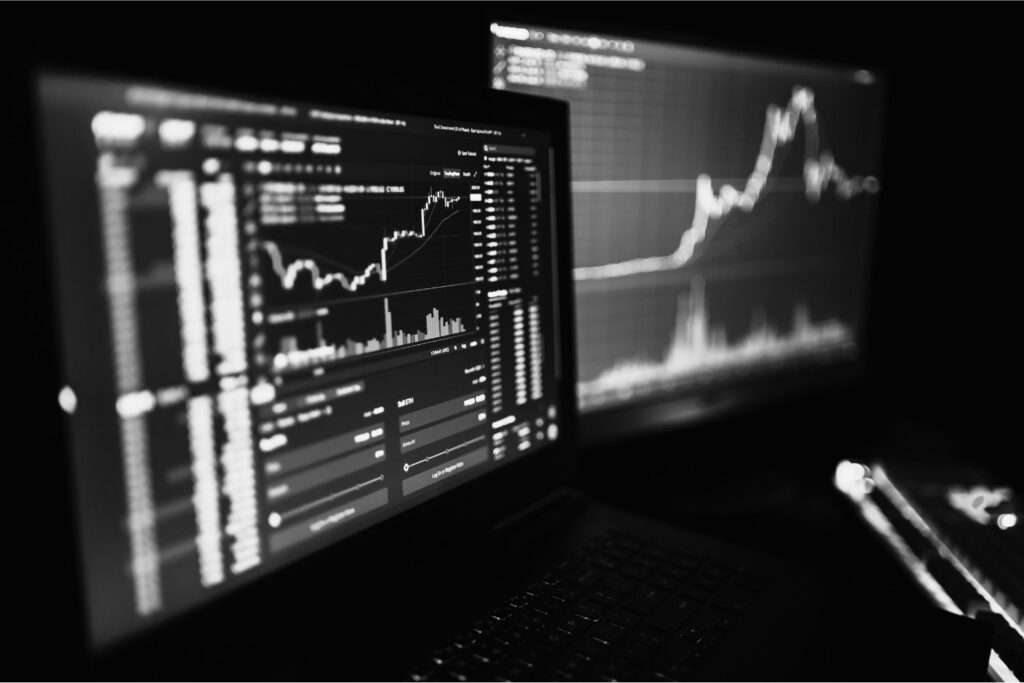
Silver doesn’t move for three hours.
Not a decimal.
You’re watching a futures contract on one of the most industrially demanded metals on earth, theoretically touched by thousands of participants across every time zone, and it sits there like a painting.
Then, without warning, it falls 4%.
The next day it does the same thing in reverse.
You get used to this faster than you should.
After a year of watching charts, across instruments I used to think were unrelated, the thing that stays with you isn’t a trading strategy, it’s a question about the word “independent.”
What independent markets are supposed to look like and what they actually look like are two different things.
Once you see the difference, it’s hard to go back to pretending it isn’t there.
Open the DAX.
Then open the NASDAQ.
Overlay them.
At some point you stop checking which is which.
They move at the same minute, they rest at the same minute, they produce the same shapes at the same time of day with the same periodicity.
Two entirely separate economies, two different geographic centers, two different underlying compositions of companies.
One chart.
Now open crypto.
ADA, SOL, ETH, XRP, LINK, DOGE.
You already know what I’m going to say.
The same shape.
The same slope.
The same sudden pause followed by the same sharp move in the same direction.
These are instruments with no intrinsic connection to each other beyond the fact that they are all called cryptocurrency, and they move as if choreographed, as if someone left rehearsal notes visible on the score.
The standard explanation is institutional correlation.
The same large players hold all of it, so when they buy, everything goes up, and when they pull out, everything falls.
This is not a conspiracy, it’s a structural fact about how capital is concentrated.
The IMF noted after 2020 that crypto and stock markets began moving in lockstep once institutional investment normalized.
Not because the assets became similar, but because the participants became the same participants.
You’re not watching different markets, you’re watching one portfolio spread across different-looking containers.
Baudrillard called the simulation the thing that replaces the original so thoroughly that the original becomes irrelevant.
The financial market’s original function was price discovery: the collective intelligence of many dispersed actors, each with different information, producing a signal about value.
That’s the theory.
The chart tells you the theory and the practice have parted ways.
When Silver freezes for three hours and then moves in one direction by a magnitude that would require a sudden coordinated decision by thousands of independent traders at the exact same millisecond, you are watching something that the theory cannot account for.
The simulation is still running.
The original function is not.
Guy Debord wrote that the spectacle is not a collection of images, but a social relationship mediated by images.
The ticker is an image.
The candlestick chart is an image.
The appearance of a marketplace, with its noise and its green and red squares and its moving averages, is an image of a mechanism that may or may not still operate underneath it.
You participate in the image whether you trade or not.
You simply get to choose whether you lose money watching it or not.
The free market is not a conspiracy.
Saying so would require a coordination too precise to sustain.
What it is, structurally, is a market in which the concentration of capital has advanced far enough that the diversity of instruments is mostly cosmetic.
Gold and tech stocks and German industrial indices and a Brazilian currency derivative can all fall on the same Tuesday at the same hour because the same institution, rebalancing its position, touches all of them.
The independence of the markets was always partly theoretical, now it’s mostly theatrical.
I started watching the charts because I thought I was late to something.
After a year I concluded that I had arrived exactly on time to watch something.
Not a game with rules I hadn’t learned yet.
A performance that had already decided its own outcome and was looking for an audience to make the whole thing feel real.
You can call that rigged.
You can call it structural.
The difference is mostly semantic.
What you can’t call it’s free.
I Can See You