
There is a question that gets searched thousands of times a month: why do people think octopuses are aliens?
You can find forum threads, YouTube videos, and half-serious Reddit debates.
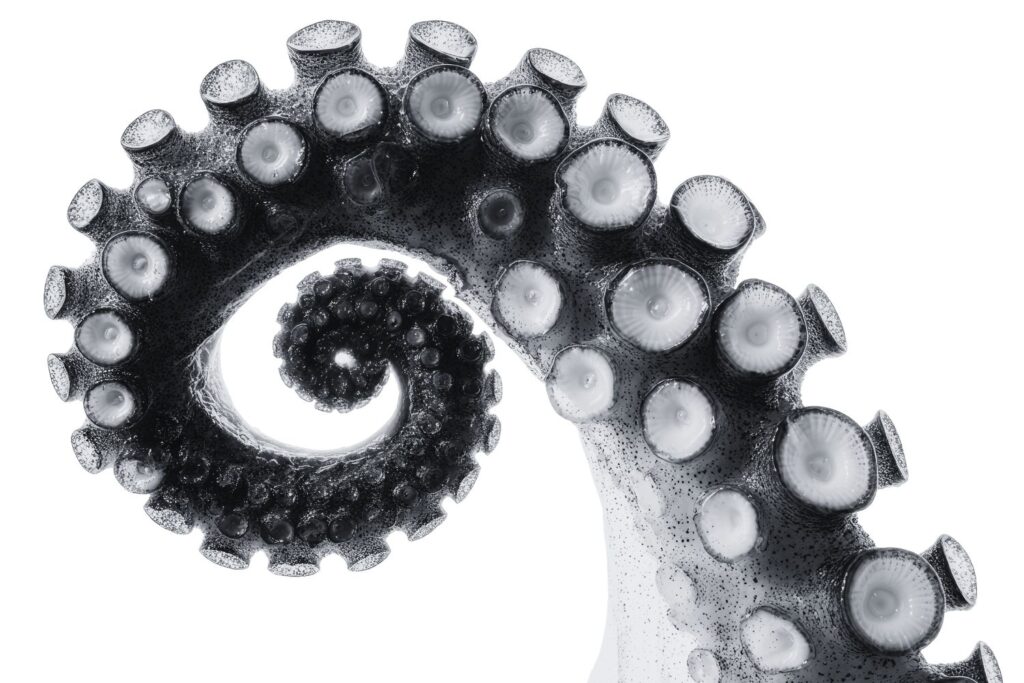
The answers tend to cite the number of tentacles, the three hearts, and the distributed intelligence across the arms.
Things that don’t match the human template get flagged as suspicious.
Things that fall outside the expected pattern are classified as unacceptable.
The octopus is not an alien.
It’s a cephalopod mollusc that evolved on the same planet, in the same oceans, over the same geological time.
It shares ancestors with the snail, but it looks strange, moves strangely, processes the world in a way our nervous system doesn’t recognize, and so the brain does what it always does when confronted with the unfamiliar, it reaches for the most dramatic available category.
This is not a problem unique to marine biology.
Watch the same mechanism at work in a conversation with someone who holds a different political view.
Or in the moment you meet a person who has made radically different choices about how to live.
Or in the low-level discomfort you feel around someone whose culture processes grief, or humor, or silence, in a way that doesn’t match your own internalized script.
The strangeness gets coded as an error.
The distance gets read as danger.
Pierre Bourdieu called this the habitus, the set of dispositions, tastes, and responses that we absorb so completely they feel like instinct.
The things that fall within our habitus feel natural.
The things that fall outside it feel wrong, or at minimum, require explanation.
The problem is that we rarely notice the boundary.
We don’t experience our habitus as a frame we’re looking through, we experience it as the shape of reality.
So, when someone calls an octopus an alien, they are not saying anything particularly interesting about the octopus.
They are telling you about the limits of their frame.
They are showing you, without knowing it, where their habitus ends.
If eight tentacles mark something as alien, then the category of “normal” is implicitly narrowed to the bipedal.
A duck is now in the same existential danger zone as a creature from another solar system.
The syllogism collapses immediately under its own weight, but that’s never the point.
The point is the comfort of the category, not the logic of the classification.
Erich Fromm observed that people don’t actually want freedom as much as they claim.
Freedom requires tolerating uncertainty, difference, and the presence of things you can’t immediately sort into familiar bins.
The alternative, which many people choose without realizing it, is a world narrowed to what confirms them.
Smaller, tidier, more manageable.
The cost isn’t philosophical, it’s practical.
Every conversation that begins with “this is alien to me” and stays there is a conversation that produces nothing.
Every relationship that stalls at the limit of the familiar is a relationship that goes nowhere.
The diversity, political, racial, cultural, sexual, doesn’t become interesting only when you have the correct ideological position on it.
It becomes interesting when you’re genuinely curious about what you’re looking at.
The octopus doesn’t care, it has three hearts and no interest in being understood.
But you, presumably, have things you want to think about.
People you want to know.
Ideas that might only arrive through contact with something that doesn’t already look like you.
The alien is whatever you’ve decided to stop looking at.
I Can See You