

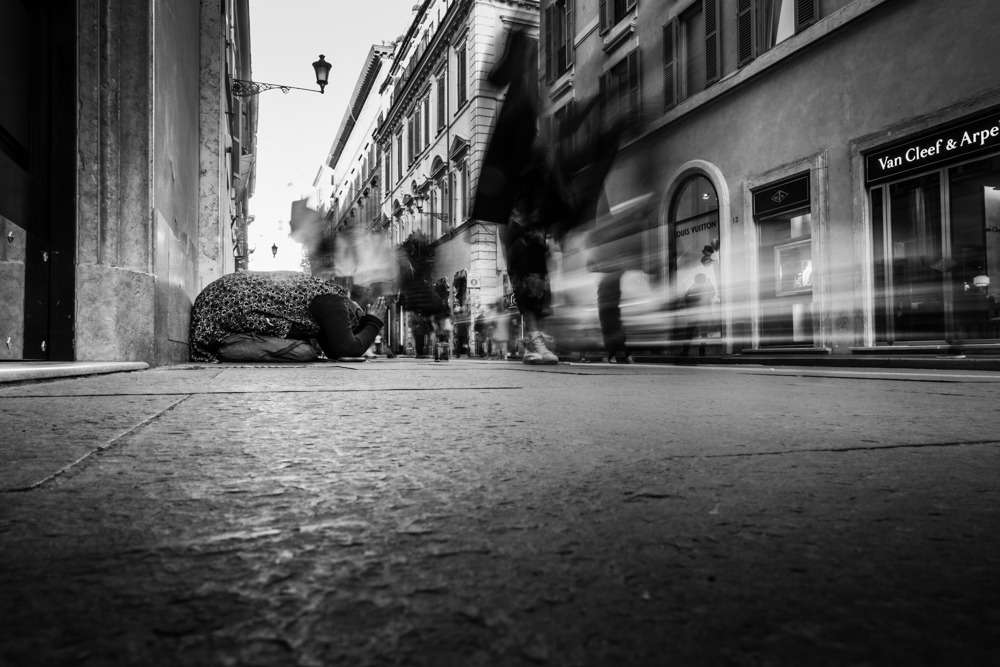
I took a photograph of a woman on her knees on Via del Corso in Rome.
Behind her, Van Cleef & Arpels, Tiffany, Hermès, and so on.
The clean geometry of wealth arranged in glass and light.
The people walking past her are not running, they simply walk, at the pace of people who have decided, in the fraction of a second it takes to register her, that she is not their problem.
To be fair, she may have chosen her spot deliberately.
Via del Corso is not an accident.
If you are going to be on your knees, you place yourself where the money walks.
There is a kind of intelligence in that, a clear-eyed reading of where visibility lives, but the people passing her have made their own calculation.
They have seen her, they have processed her, and they have kept walking.
Psychologists have a name for this.
The bystander effect, first described by Darley and Latané in 1968, proposes that the more people are present in an emergency, the less likely any one of them is to help.
Responsibility diffuses across the crowd until it belongs to no one.
Everyone assumes someone else will act.
The woman on Via del Corso has dozens of potential helpers walking past her every minute.
She has, by the logic of probability, never been more surrounded by people capable of helping her.
She has also, by the same logic, never been more alone.
But I want to stay with that calculation for a moment, because I think the standard explanation: confusion, diffusion, the passive mechanics of crowd behavior, lets us off too easily.
The people walking past her are not confused about what they see, they are not paralyzed by uncertainty.
They have looked, understood, and decided.
The bystander effect, at its most honest, is not a malfunction, it is a feature.
It is the moment a person does the math and concludes that helping costs more than not helping.
Now scale that up.
Gaza has been burning for over a year.
The images have been everywhere: on your phone, on your screen, on the face of anyone who has not managed to stop looking.
Children, hospitals, numbers that stopped being abstract a long time ago.
Israel has continued, systematically, with the institutional protection of governments that know exactly what they are watching.
They are not suffering from diffusion of responsibility.
They have looked, they have understood, they have decided that the cost of confrontation is higher than the cost of complicity.
This is the part that the psychology textbooks tend to skip, and no bystander effect explanation points to when giving real life examples.
The bystander effect in a laboratory is about ambiguity: smoke in a room, a voice in distress, the uncertain question of whether this is actually an emergency.
But there is nothing ambiguous about a genocide.
The mechanism is the same, but the moral architecture is different.
When you pass a woman on Via del Corso without stopping, you have done something small, common and human.
When a government watches a documented extermination and continues to trade, to arm, to veto, it has done something for which the word indifference is already too gentle.
Simone Weil wrote that attention is the rarest and purest form of generosity.
To truly attend to another person, to let their reality land on you without immediately calculating what it will cost is, she argued, a moral act in itself.
The inverse is also true.
To see clearly and choose not to act is not neutrality, it’s a position.
The woman on the pavement, the bodies in Rafah, they exist in the same structure of chosen non-seeing.
The scale is different.
The mechanism is the same.
Each one, at some level, represents the bystander effect using real life examples.
What the photograph shows, and what no amount of geopolitical language quite captures, is the texture of that choice.
The people on Via del Corso are not monsters.
They are people who have decided, this morning, not to carry something they were not asked to carry.
You recognize them, you may have been them.
The question the photograph asks is not whether they are good or bad, it’s whether the math they are doing, the quiet invoice they are writing back to the woman on the ground, is one they would recognize as a choice if someone named it out loud.
Most people, when they walk past, do not think: I am choosing not to help.
They think: someone else will.
Or: there is nothing I can do.
Or, most honestly: I cannot afford, right now, to let this in.
Gaza teaches us that this logic scales perfectly to the level of states.
I Can See You