
There is a photograph I keep coming back to.
A man on a street corner, mid-stride, looking directly at the camera without seeing it.
His eyes are open, his mind is somewhere else.
I took it on a Tuesday afternoon, and the reason it still interests me is not the man, it’s what his face reveals about the difference between two things we constantly confuse: looking and seeing.
Looking is mechanical.
Your eyes open, light enters, the brain files a report.
You looked at the door when you walked through it this morning.
You looked at the coffee cup.
You looked at the face of the person who spoke to you at 9am.
None of this required you to actually be there.
Seeing is something else.
It requires a kind of stopping, not physical, but interior.
Roland Barthes wrote about photographs containing two distinct forces: the studium, the general field of interest that any informed viewer might register, and then the punctum, the small detail that pierces you, that reaches out and marks you personally.
The punctum is not found by looking, it arrives only when you allow the image to look back.
Photography made this distinction impossible for me to ignore, because the camera is brutally honest about attention.
You can point a lens at something and still not see it.
The frame captures what was in front of you, it does not capture whether you were present for it.
Looking through ten thousand images from a single year will tell you exactly where your mind was, and where it wasn’t.
But the problem extends far beyond photography.
You can look at a painting for thirty seconds and retain nothing.
You can look at someone’s face during an argument and fail entirely to understand what is happening in it.
You can look at the same problem for three years and still not see what it actually is, because seeing requires you to set aside what you expect to find, and looking almost never does.
Merleau-Ponty argued that perception is not a passive recording but an active, embodied engagement with the world.
We don’t receive images like a screen receives light.
We reach out toward what we perceive, bring our history and assumptions and fatigue along with us, which means that most of what we call seeing is actually a form of recognition, we find what we already know, and call it observed.
Simone Weil had a more uncomfortable version of the same idea.
She described genuine attention as the suspension of thought, a radical willingness to receive rather than project.
To really look at something, she argued, you have to stop filling it with yourself.
That is extraordinarily difficult.
It is also, when it happens, the closest thing to clarity most people will experience.
The street taught me this.
Not as a lesson but as a correction.
I would go out with the intention of photographing something specific: a quality of light, a type of crowd, a neighborhood, and come back with nothing.
Then, on the days I went out without a plan, without a concept to confirm, something would open, not always, but enough times that I started to understand the difference between hunting and receiving.
The camera is just the arena where the distinction becomes legible.
The same thing happens when you read a book but don’t let it disturb you.
When you sit across from someone but stay safely inside your own interpretation of them.
When you look at your own life but only at the version of it you’ve already decided is true.
Learning to see in photography is a technical phrase.
It refers to composition, light, timing.
Most people never develop it.
Not because they lack the capacity, but because looking is faster, and faster has become the default.
You can get through an entire day, an entire year, on looking alone.
The question is whether you want to.
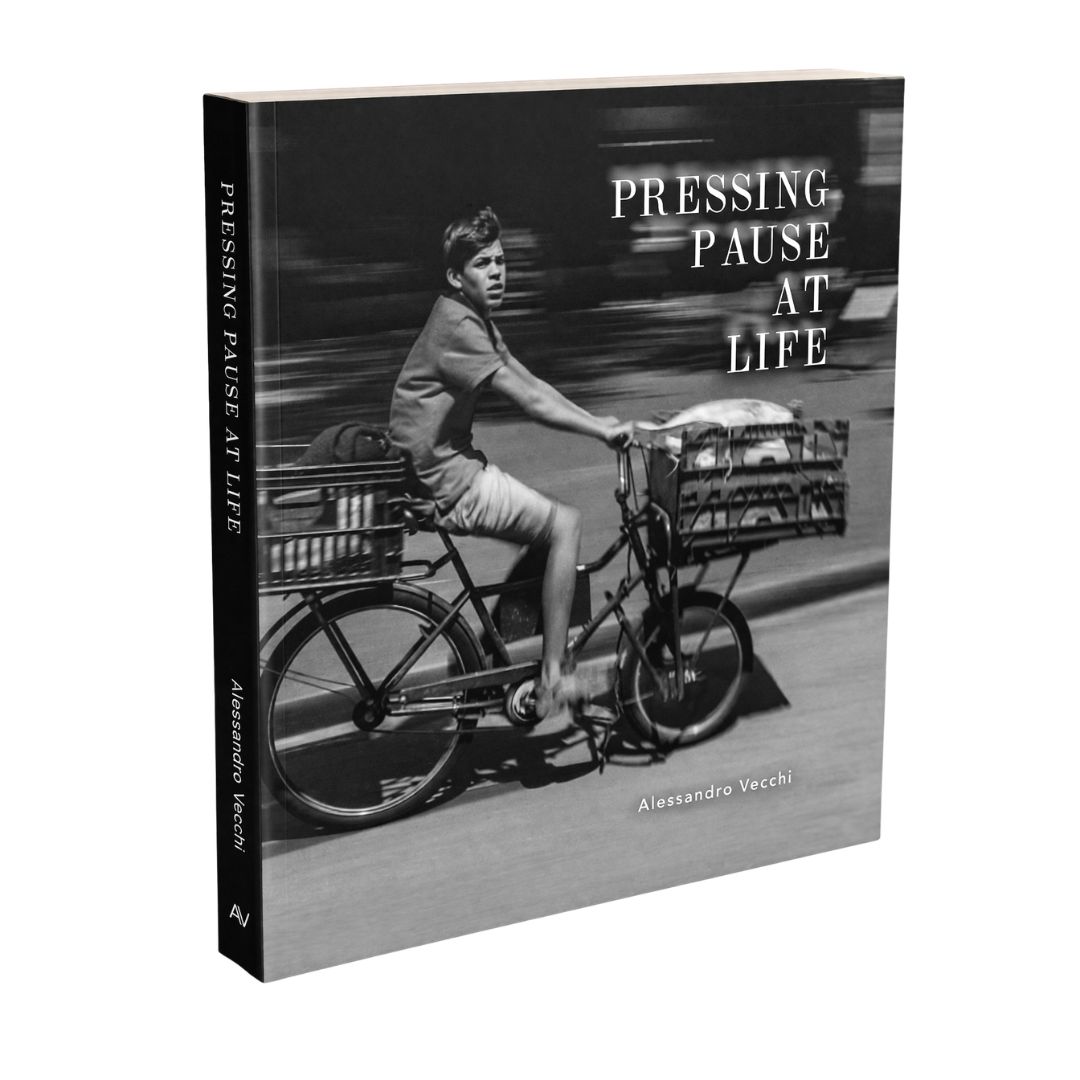
Pressing Pause at Life
240 pages of street photography paired with philosophical reflection. An invitation to notice what you've trained yourself to ignore: light on walls, silence between strangers, the weight of ordinary moments. The city was always saying something. This book teaches you to listen.