

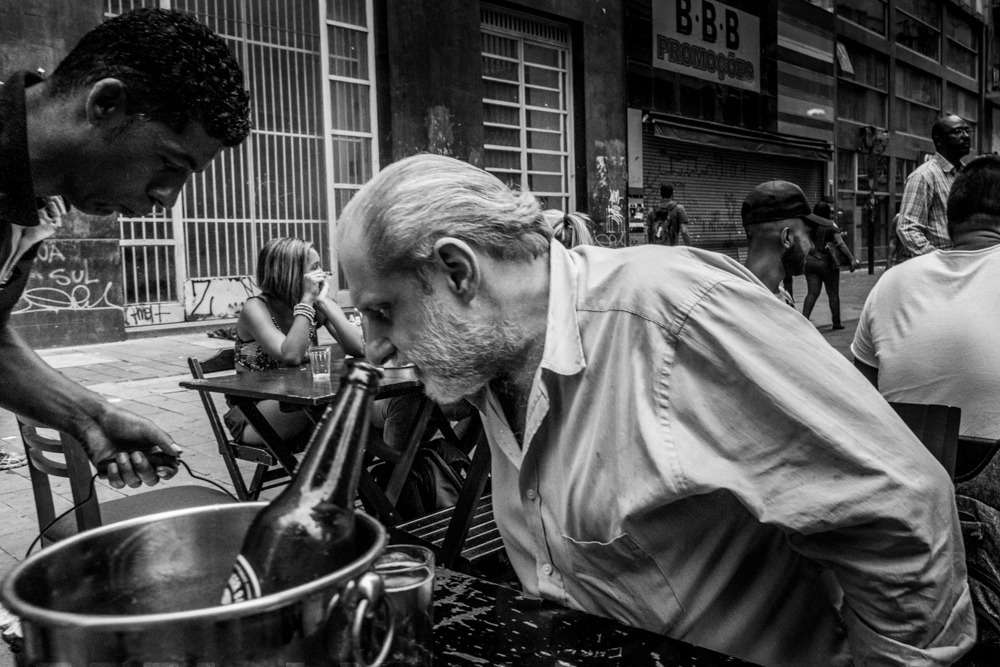
Most people who read about the decisive moment immediately think about speed.
They think about the shutter, the fraction of a second, the eye and the finger arriving at the same point simultaneously.
They think it’s a physical problem with a physical solution.
Well, it isn’t.
Cartier-Bresson used the phrase, and the photography world seized it and turned it into a technique.
Into something you could learn by practicing fast reflexes.
Into a speed drill, which is a little like reading about Zen archery and deciding the main lesson is to release the string faster.
What Cartier-Bresson was describing was not the moment of pressing the shutter, but a mental condition that preceded it.
A kind of receptivity so complete that when something happened in front of him, his body already knew.
The shutter was the last thing.
The rarest thing in the process, actually, was not the release, it was the state of readiness that made the release possible.
Merleau-Ponty, who thought hard about what it means to perceive a world with a body rather than just a mind, would have recognized this immediately.
He argued that skilled action is not a series of decisions.
The carpenter does not decide where to place each nail.
The musician does not consciously form each chord.
There’s a kind of pre-reflective intelligence that lives in the trained body, below the level of deliberate thought.
Street photography, at its best, works the same way.
The problem is that most of us arrive on a street and start scanning.
The eye moves like a search engine: input, input, process, flag.
We’re looking for photographs.
We’re looking for the decisive moment.
Which is precisely why we miss it.
Bergson made a distinction between time as we measure it and time as we live it.
The clock divides duration into equal units, but experience is not equal.
There are states of consciousness that are thick, expanded, saturated with attention, and there are states that are thin, mechanical, running on autopilot.
The decisive moment does not live on the clock, it lives in the thick kind of time.
You can’t arrive at it by moving faster, you arrive at it by slowing something internal down.
This is the gap that separates taking pictures from seeing.
You can go out every Saturday with good equipment and return with technically correct images that feel like records.
Or you can stand on a corner for twenty minutes, absolutely still, not hunting, not editing in your head, not calculating light, and watch something unfold in front of you that your whole body recognizes before your mind names it.
The shutter follows, almost automatically.
The people who search for the decisive moment as a technique will spend years improving their reaction time.
That’s not nothing, but the photographers who understand it as a mental state start training a different thing entirely, the capacity to be present on a street in a way that feels, honestly, closer to a particular quality of attention than to anything technical.
The two are related in ways that run deeper than most photography tutorials will tell you.
The decisive moment is not something you catch, it’s something you’re ready for.
And readiness, it turns out, is mostly a question of where your mind is before you ever lift the camera.