
You get in the pool. Twenty lanes, each one 25 meters long.
Someone tells you the goal is 5 kilometers.
You look at the water. You feel something close to grief.
That feeling has nothing to do with your fitness.
It has to do with what your brain just attempted to process.
The entire distance, all at once, before you’ve even touched the water.
That’s not preparation. That’s cognitive overload with a swimsuit on.
We talk about cognitive overload as if it’s a modern disease, something the internet invented.
Pascal wrote about it in the 17th century.
He observed that nearly all of human suffering comes from a single source, the inability to sit quietly in a room.
His version of the pool was the court, the conversation, the affair, the hunt. The noise changes. The mechanism doesn’t.
What the brain cannot do is hold an infinite number of open loops without cost.
Kahneman’s work on cognitive load makes this precise: working memory is genuinely limited. It’s not a metaphor.
When you fill it with too many simultaneous demands, something drops, usually the thing that mattered.
The internet didn’t create this problem. It industrialized it.
Every platform, every notification, every “quick read” is an open loop handed to you without your consent, and the peculiar trap of our era is that the response to overload has become more information.
A framework. A productivity system.
A thread on how to manage your inbox.
You load up on solutions and end up with the same problem plus the weight of the solutions.
There’s a woman I used to run with years ago, in the days when running was still an act of reluctant solidarity on my part.
She had a method so simple it bordered on absurd. “Just go to that tree,” she’d say.
Then, once we got there, she’d point to another one.
She never told me the total distance. She probably knew I wouldn’t have moved.
That’s not a metaphor for positivity.
It’s an operational description of what the brain can actually handle.
One thing. Then another.
The advertising world has its own version of this.
An art director worth anything does not sit down at a computer and start designing.
The computer is the enemy precisely because anything is possible.
Before opening a single file, the idea has to exist, cleanly, in the head.
The screen then becomes execution, not exploration. You stop the loop before it starts.
This is what Simone Weil was pointing at when she wrote about attention as a discipline, something closer to muscular training than inspiration.
Real attention is not exposure to more, it’s the practiced refusal of most things so that one thing can come into focus.
The question isn’t how to manage the noise.
It’s whether you’ve decided, before sitting down, what you’re actually trying to do.
Not in the abstract. Specifically.
Because billions of paths exist for nearly every task, and the brain that has not chosen one in advance will attempt to evaluate all of them simultaneously.
That’s not thinking. That’s the pool.
What most people call cognitive overload is the tax on indecision.
The noise is loud, yes, but you let it in at the door.
The first tree is enough.
Go there.
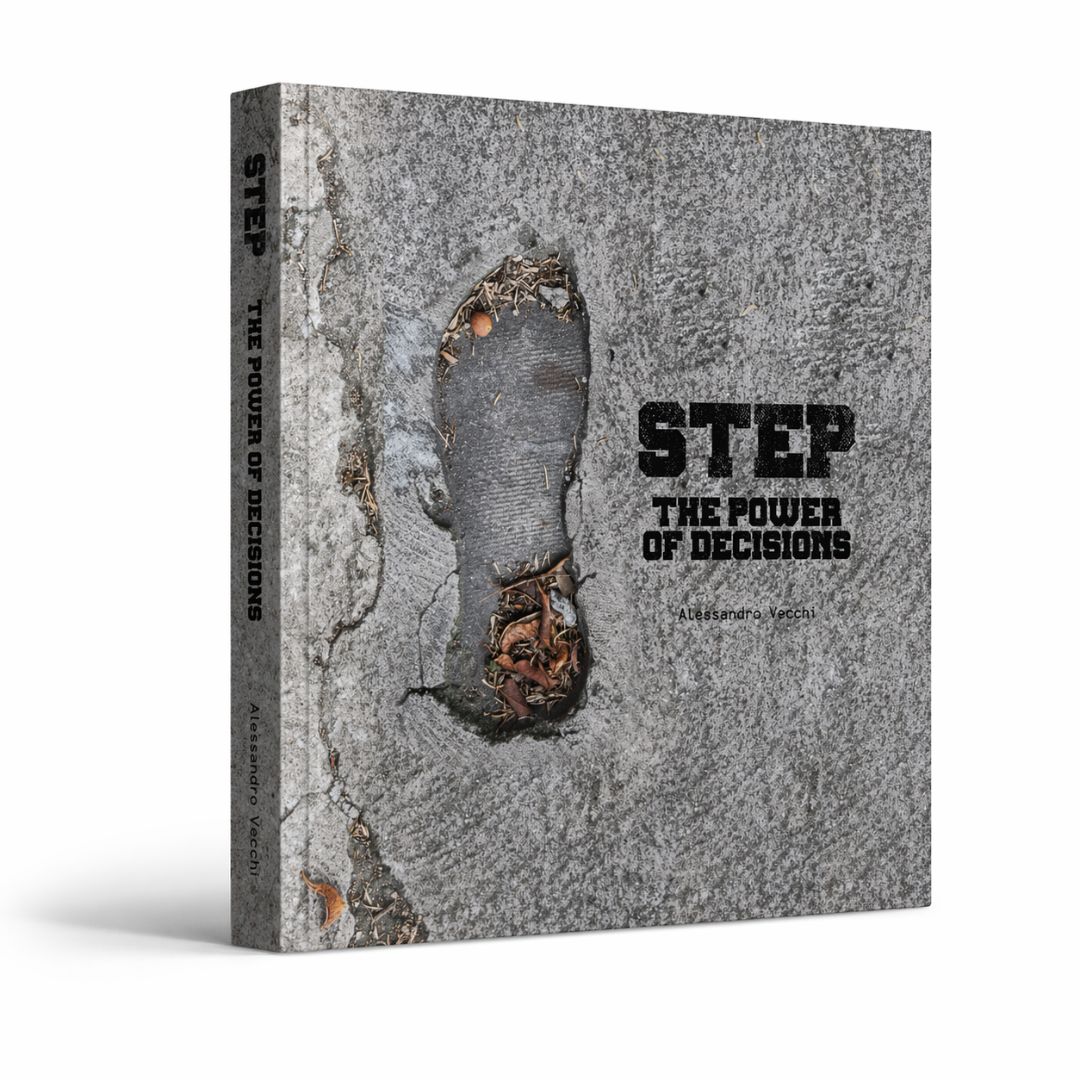
Every life is the sum of its steps. Not the grand ones, the quiet, daily ones we barely notice making. STEP is a visual and narrative journey through the architecture of personal choice. How decisions accumulate, how resilience isn't a gift but a response, and how self-discovery doesn't arrive announced, it shows up in the rearview mirror.
Through a blend of photography and reflection, this book offers a mirror. For those willing to look at the choices that brought them here, and the ones still ahead.