
One Frame, One Film.
You stop in front of a photograph, and something happens.
Not recognition, something slower. You stand there longer than you meant to.
The image keeps giving you something back, and you’re not entirely sure what it is or where it’s coming from.
This is not an accident, and it has almost nothing to do with what the photograph shows.
There is a category error people make when they talk about photography.
They say a great photograph “tells a story.”, but a photograph is a single frame.
It has no before and no after, no cut, no soundtrack, no time to build anything.
Every suggestion of a story that exists in that image, the gesture half-finished, the shadow arriving from somewhere offscreen, the face that is doing two things at once, has to live inside a quarter of a second.
The photograph doesn’t tell you anything. It holds everything.
Roland Barthes called it the punctum: the detail in an image that pricks you, that finds something in you you didn’t know was there to be found.
Not the subject of the photograph. Not the official content. A hand. A shoe.
The angle of light on the wrong surface.
Something that doesn’t announce itself but that you keep returning to.
The studium, what the photograph is about, is what you understand.
The punctum is what hits you.
Cartier-Bresson spent his life hunting for what he called the decisive moment, the fraction of a second in which the geometry of the world aligns, the movement crystallizes, the meaning becomes visible, and then immediately disappears.
He wasn’t talking about speed, he was talking about density, the decisive moment is memorable because it contains more than a moment.
It contains the tension before it, and the release after it, and the distance between the two, all frozen, all simultaneous.
Tarkovsky said cinema sculpts in time.
Photography has no time to sculpt.
The photographer has to find a moment that already contains time inside it, coiled, compressed, waiting to be released by whoever is standing in front of the frame.
This is what separates a photograph you forget the second you scroll past it from one that lives somewhere in you for years.
The forgettable image shows you something.
The memorable image holds something in suspension.
A decision not yet made. A story with the middle removed. A person mid-translation between who they were a second ago and who they’re about to become.
The implication for how you look at photographs, through a camera, at anything, is uncomfortable.
It means most of what you see has already been digested before you’ve finished seeing it.
The eye moves on.
The frame was empty before you arrived.
Real looking is slower than that, and harder, and less comfortable.
You have to stay with the image past the point where your brain has already summarized it.
The photographs that stay with you are the ones that refuse to be summarized.
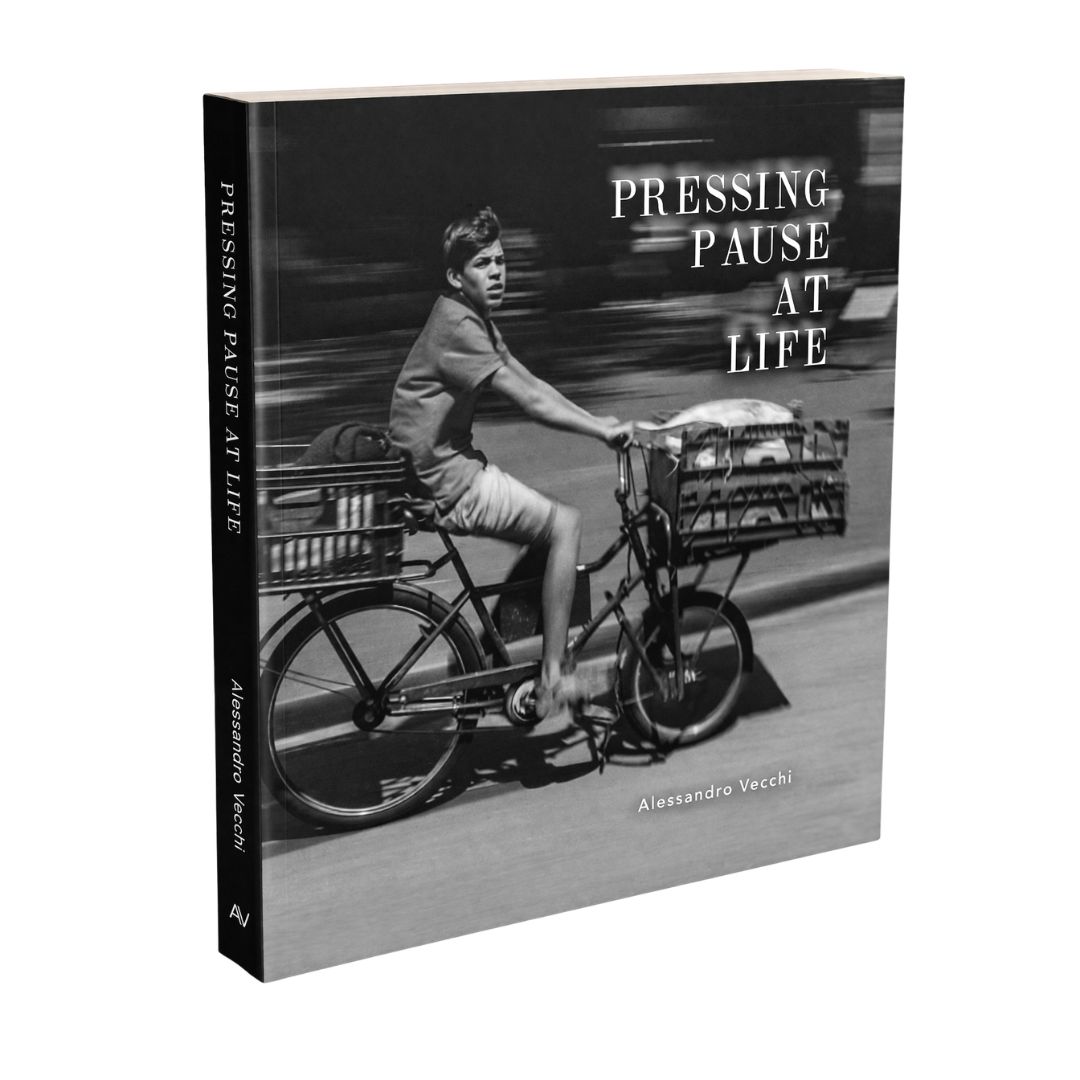
Pressing Pause at Life
240 pages of street photography paired with philosophical reflection. An invitation to notice what you've trained yourself to ignore: light on walls, silence between strangers, the weight of ordinary moments. The city was always saying something. This book teaches you to listen.