

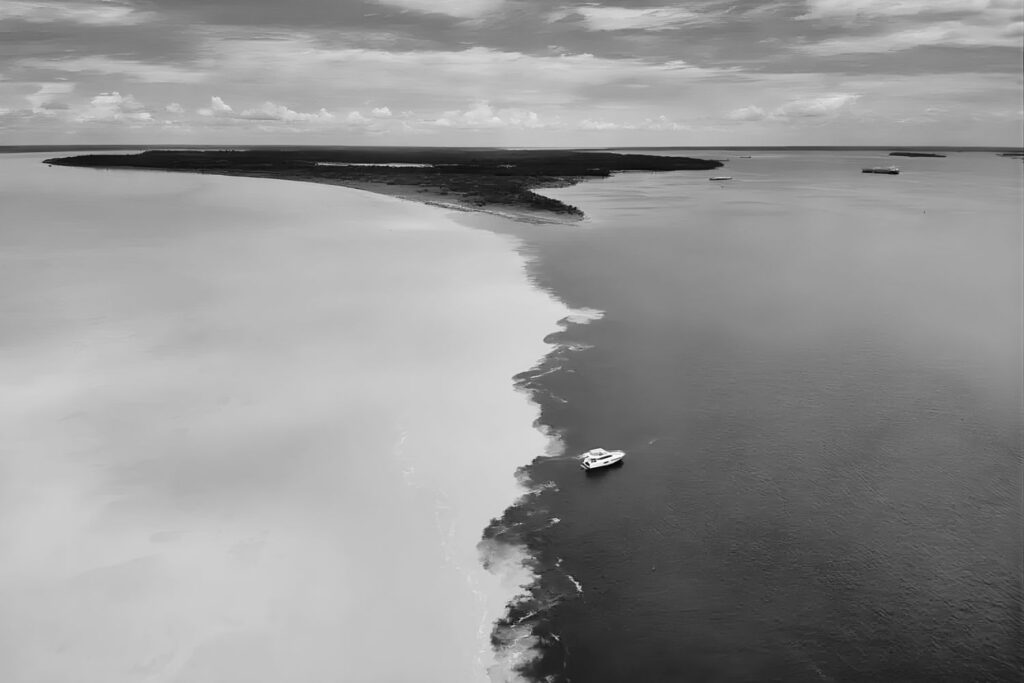
Near Manaus, in the Amazon, two rivers meet without mixing.
The Rio Negro runs dark, cold, fast. The Rio Solimões runs warm, muddy, slow.
They flow side by side for kilometers. Same direction. No contact. Until they become the Amazon.
This is not a metaphor I invented.
It’s an actual place you can visit, stand on a boat, and watch.
I find it useful because most metaphors for the inner life are deliberately vague. This one is specific.
Two adjacent things, moving in parallel, not yet the same thing.
Self-awareness and self-esteem are like that. Adjacent. Often confused, rarely mixed.
Self-awareness is the act of seeing clearly.
You look in the mirror and you note what’s there.
Not what you wish were there. Not what you used to look like. What’s there.
It’s a perceptual act, and it requires a kind of cold neutrality that most people spend considerable energy avoiding.
Self-esteem is something else entirely. It’s relational.
It’s the degree to which what you see in that mirror matches what you feel you deserve to see.
Low self-esteem doesn’t mean you see poorly.
They see clearly and they don’t like what they see, and they stop there, because the gap between perception and desire feels uncrossable.
So the question isn’t whether awareness can exist without self-esteem. It clearly can.
The harder question is what awareness without self-esteem actually produces, because in isolation, it can produce paralysis.
Worse, a very articulate paralysis, the kind where you can explain exactly what’s wrong with your life in precise detail while changing nothing about it.
There’s a concept in the psychology of self-regulation that maps this cleanly.
Your future self is neurologically processed as a stranger. Not you. Someone else.
When you leave something undone, or eat the thing you said you wouldn’t, or postpone what you keep calling important, you are not being lazy in the conventional sense.
You are failing to feel solidarity with a person you can barely imagine, which means that doing what you said you would do is a form of care.
Not discipline in the punitive sense. Not willpower. Care.
The kind you extend to people you love, applied inward.
The thing you leave undone today lands on someone who will already have other problems.
You are adding to their load.
The person looking at the mirror six months from now, the one who can smile at what they see, exists only if someone starts now.
That someone is you, except you feel it as an abstraction, which is why you keep postponing it.
The two rivers don’t mix by accident.
There are physical forces involved: temperature differentials, density, and the particular geometry of that confluence.
They merge because conditions are eventually right.
Awareness is necessary.
It tells you where you are and what needs changing, but it merges with something worth calling care only when you extend it forward in time, when you let the fact of your future self become as real as your present discomfort.
That’s the moment the rivers stop running parallel.
What makes you think they haven’t already started?
The Last High
Most addiction books want to help you feel understood. This one wants you to feel responsible. The Last High isn't about substance abuse. It's about escape, and the uncomfortable reality that everyone is escaping something. Written from the inside, without sympathy asked or given.