
There is a van parked in front of a brick wall. That’s it.
No person, no drama, no golden hour.
A van. A wall. It sells.
Not because it’s a van or because it’s a wall.
Because someone walked slowly toward it, music in the headphones, zigzagging, reading the scene the way you read a room before you understand why it makes you uncomfortable.
The photo exists because of what happened before the shutter. The shutter is the last five percent.
This is the thing most people miss when they ask whether photography is art.
They start at the wrong end.
They look at the result and debate the category.
Art, not art, street photography, not street photography.
The debate is usually a waste of time, and it almost always involves people who are not making anything.
Any medium can produce art.
A piano doesn’t make music. A brush doesn’t make a painting. A camera doesn’t make a photograph, not in the sense that matters.
The medium is just the surface where the transformation lands.
What precedes it is either something or it isn’t.
Sontag argued that photography democratized image-making in a way that made it suspect that everyone with a machine could now produce a picture, which blurred the line between capturing and creating.
She wasn’t wrong about the blurring.
She was wrong to treat it as a problem unique to photography.
Writing is also democratic. So is paint. Most of it is forgettable.
That’s not an argument against the medium. That’s just the ratio.
Barthes got closer. He wrote about the punctum, the detail in a photograph that pierces you, that wasn’t put there for you, that lands anyway.
The thing that wasn’t composed so much as found.
He was describing the gap between what the photographer intended and what the image contains.
Sometimes those two things are the same.
Sometimes the image knows more than the person who took it.
Cartier-Bresson called it the decisive moment, which is often misread as speed.
It has nothing to do with speed. It has to do with readiness, a particular quality of attention that makes you present enough to notice when the geometry of a scene resolves into something true.
You can’t manufacture it. You can only be available for it.
Street photographers who shoot on zoom lenses are not wrong. They’re just not in the scene.
They’re observers from a distance, which produces a different kind of image, sometimes powerful, usually illustrative.
But the photographer who works at 35mm has made a different choice.
You have to be close.
Close means the person you’re photographing can see you, and you can see them, and something passes between you before the shutter closes.
That pressure is the material.
A flower photograph can be art. So can a van against a brick wall. So can a portrait of someone sleeping.
The category of subject has nothing to do with it.
The angle, the point of view, the decision to crop the familiar out of the frame until what remains looks more like a problem than a flower, that’s where it either becomes something or it doesn’t.
Whether to call it art is a different question, and not a particularly interesting one.
The more honest question is whether the image contains something that wasn’t in front of the camera before the photographer arrived.
Not as a philosophical trick. As a practical test.
Look at the photo.
Remove the photographer from the scene.
Does the image still exist?
If the answer is yes, you have a record.
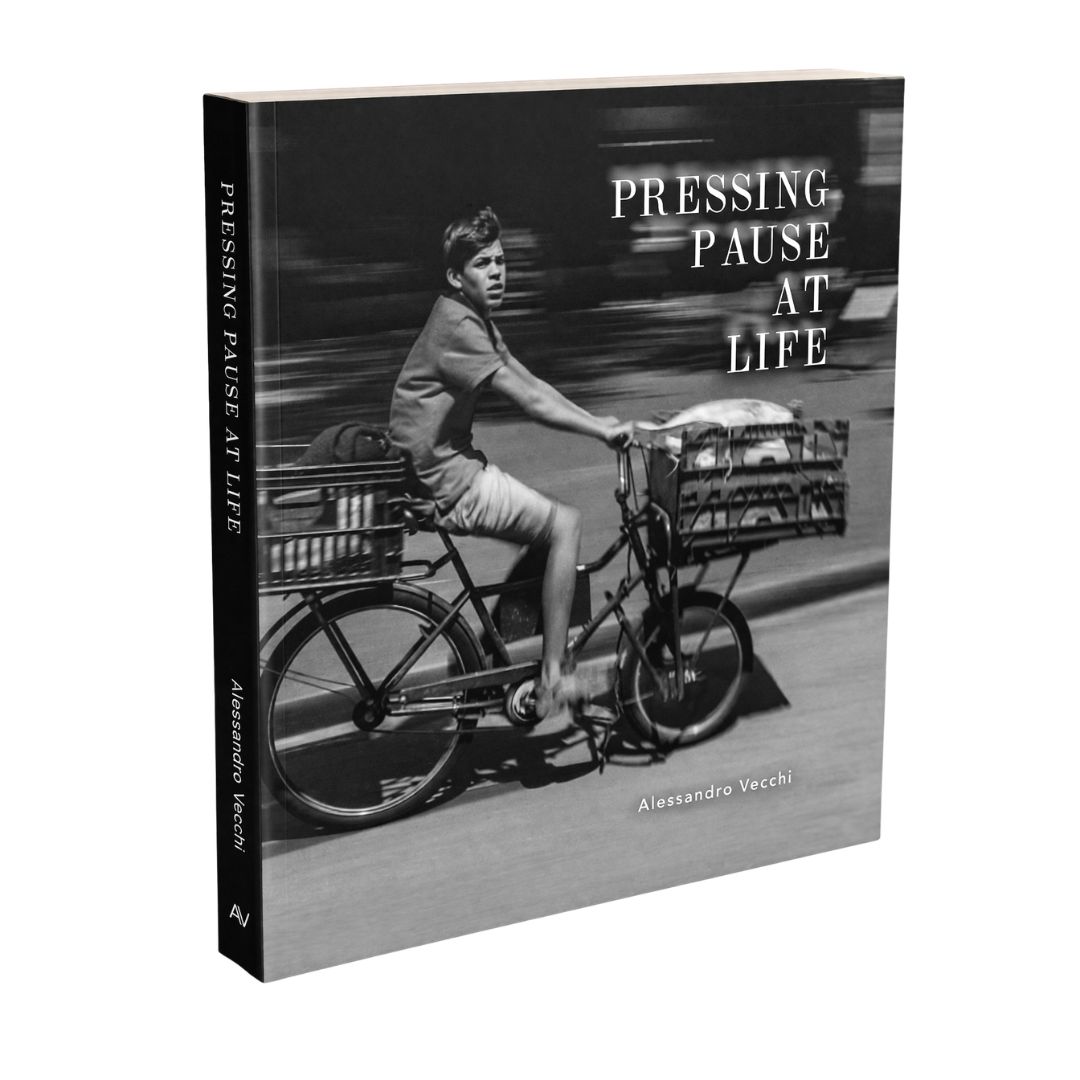
Pressing Pause at Life
240 pages of street photography paired with philosophical reflection. An invitation to notice what you've trained yourself to ignore: light on walls, silence between strangers, the weight of ordinary moments. The city was always saying something. This book teaches you to listen.