
Most people pick up a camera and try to include things.
They move closer to the subject, pull back for context, and wait for the light to do something useful.
They are building, adding, assembling pieces into an arrangement that, at some point, seems to work.
This is the wrong direction.
Composition is not what you put in, it’s what you agree to leave out.
Every image you’ve ever seen that stopped you, not the technically correct ones, the ones that stopped you, was built on a series of refusals.
The photographer chose not to include that lamppost, chose not to wait for the street to empty, chose to let that blurred figure stay at the edge of the frame rather than move two steps to eliminate it.
Henri Cartier-Bresson talked about the decisive moment as if it were about time, the perfect instant, the fraction of a second that contains everything.
What he was actually describing was something closer to a spatial argument.
The moment was decisive because, at that exact point, every element in the frame agreed to be in conversation with every other element.
Not harmony, conversation, sometimes disagreement, but nothing was present by accident.
This is harder than it sounds because the eye doesn’t see in frames, it scans, it moves constantly, filling in gaps, building a continuous picture from selective information.
The camera doesn’t do this.
The camera makes a rectangle and keeps everything inside it, permanently.
What felt like peripheral background when you pressed the shutter becomes, in the photograph, a competing subject.
The eye forgave it, the frame does not.
Roland Barthes wrote about two kinds of looking in photography: the studium, the cultural reading of an image, what it’s “about”, and the punctum, the detail that escapes the frame’s intention and reaches out to wound you.
The photographer plans the studium.
The punctum arrives uninvited.
You cannot design it, but you can refuse to crowd it out.
This is why more experienced photographers often seem to do less.
They don’t move more, they move less, they wait, they let the scene resolve itself.
What looks like patience is actually a kind of negative work, resisting the impulse to intervene, to redirect, to improve.
The frame clarifies when you stop insisting on what you want it to say.
Robert Bresson, the filmmaker, had a line about his actors, he didn’t want performances, he wanted presences.
He filmed the same scene dozens of times until the actor was too tired to act, and only then did the camera find something true.
Composition in photography works by a similar logic.
You photograph a scene enough times, from enough angles, until you stop trying to make it beautiful and start trying to make it honest.
The image you keep is rarely the one you expected.
So when someone asks how to get better at composition, the answer is not a list of rules, not the rule of thirds, not leading lines.
These are training wheels, useful for a moment, structurally misleading if kept too long.
They teach you to place things, they do not teach you to see.
What teaches you to see is the practice of removing.
Print your contact sheet and mark every image where something in the frame bothers you, then ask yourself not what was wrong with the frame, but what you were afraid to exclude.
The answer is usually the same, everything that felt important before you pressed the shutter.
The frame is not a window, it’s an argument.
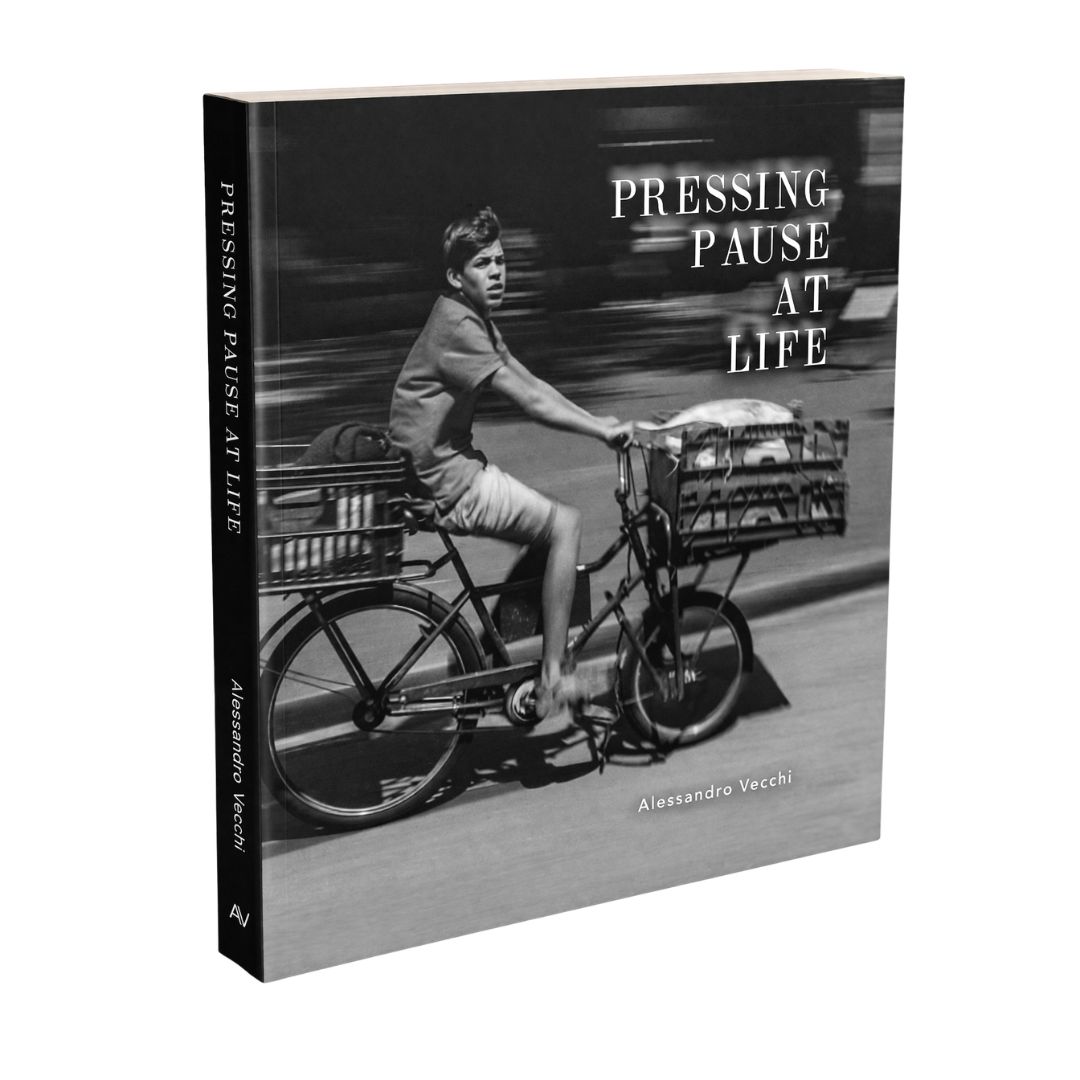
Pressing Pause at Life
240 pages of street photography paired with philosophical reflection. An invitation to notice what you've trained yourself to ignore: light on walls, silence between strangers, the weight of ordinary moments. The city was always saying something. This book teaches you to listen.