
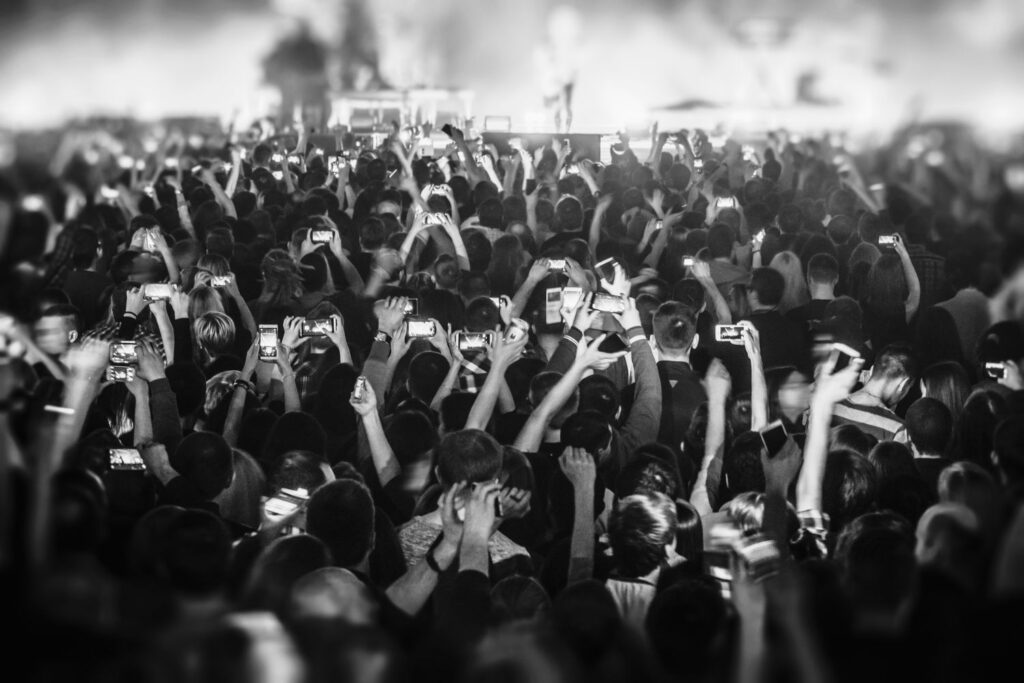
I was at a concert, the kind where you can feel the bass in your chest, and I watched as thousands of people held their phones up.
Not to experience the moment, to prove they were there.
Here’s the question nobody wants to ask: Why do we feel the need to document everything online?
Not the surface answer, not “because social media” or “because we’re all addicted.” Deeper.
Why does a moment only feel real when someone else sees it?
Why does your vacation need witnesses?
Why can’t you eat a beautiful meal without photographing it first?
I think it comes down to this: we’re afraid we don’t exist unless we’re seen.
It sounds paranoid when you say it out loud, but it’s true, isn’t it?
If you spent a day alone and didn’t post anything, didn’t tell anyone where you were, didn’t share what you thought, would that day have mattered?
Would you have lived it?
The digital world taught us something new about existence.
You’re not real unless you’re visible.
You don’t matter unless you’re counted.
Your thoughts don’t exist unless they’re liked.
Your experiences aren’t authentic unless they’re witnessed.
We’ve internalized this so completely that we can barely remember any other way of being.
So we document, obsessively.
We turn every moment into content because content is proof, it’s evidence.
It says: I was here, I did this, I felt this, see me.
But here’s what gets lost in the translation from life to content: the actual feeling.
When you’re filming a sunset, you’re not watching the sunset. You’re watching your phone screen capture the sunset.
You’re already one step removed.
Your experience is mediated, filtered, and curated.
By the time you upload it, you’ve lived it three times: the moment itself, the documentation of the moment, and the performance of the moment.
The original is buried somewhere underneath.
I read once that we remember moments better when we photograph them, research says so.
We become strangers to our own lives.
They’ll go home, scroll through the image three times, and forget about it.
But they won’t remember standing in that room.
They won’t remember how the light hit the canvas, or the feeling of being present in front of something beautiful.
They’ll remember the filtered photograph.
We’ve outsourced our memory to our devices, our presence to an invisible audience, our authenticity to an algorithm.
And the thing that kills me is this: it’s not an accident.
It’s not even really social media’s fault, though that’s easier to say, it’s that somewhere along the way, we decided that living wasn’t enough.
We needed proof, we needed witnesses, we needed external validation that what we were experiencing was worth experiencing.
We learned to doubt our own presence unless someone else confirmed it.
When did that happen?
Why do we feel the need to document everything online?
I think it’s because attention became currency.
In a world where visibility equals value, invisibility feels like death.
If no one sees your life, does your life matter?
If your thoughts aren’t shared, are they even thoughts?
We’re fighting to be seen in a world that’s learned to ignore everything that doesn’t glow.
So we perform, we curate, we document, but here’s what I’ve noticed: the moments I actually remember, the ones that shaped me, are never the ones I photographed.
They’re the ones I was too present to think about capturing, I was completely absorbed in conversation, in work, in looking at someone’s face.
In those moments, I forgot about the audience.
There was just the moment, and me in it, completely.
Those are the moments that stay.
I Can See You