

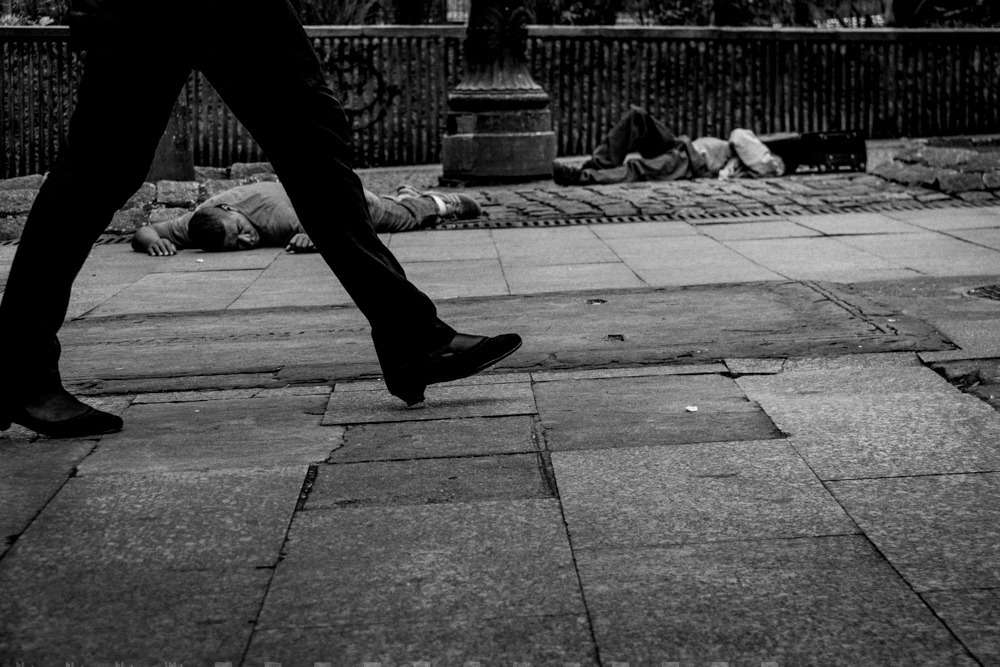
You step onto the sidewalk with a camera in your hand and the city closes around you.
People move in their orbits, briefcases swinging, phones pressed to ears, eyes fixed on some point just beyond the next crosswalk.
You raise the lens not to capture a face for its own sake, but to notice how one glance meets another across the frame.
A woman in a red coat pauses at the curb, a man in a suit checks his watch at the exact moment her shadow falls across his shoes.
The shutter clicks. Something small has been joined.
Street photography does not invent connections, it subtracts everything that hides them.
You frame tightly enough that the noise of the avenue falls away, and what remains is the line between two strangers who will never speak.
Their postures echo each other without intention.
One leans forward as if listening, the other tilts back as if already answering.
In the viewfinder, you see the geometry of a conversation that never happened, yet feels inevitable once noticed.
The camera becomes a quiet insistence: look again, look closer, look at what you usually edit out while walking.
You carry your own mask into these streets.
The role of observer, the posture of someone who belongs nowhere in particular and therefore can stand anywhere.
The face you present to the world does not demand more of you than you are willing to give, loosens slightly behind the lens.
You are no longer performing availability to colleagues or clients, you are performing attention to what is right in front of you.
The difference is subtle but precise.
One performance flatters the expectations of others, the other simply records what refuses to flatter anyone.
The act reverses the boardroom habit.
There, you learned to add layers, agendas, slides, polite fictions, so decisions could be reached without anyone looking too directly at anyone else.
On the street you remove layers until only the essential tension remains: a hand reaching for a door handle while another hand lights a cigarette three meters away.
The image does not explain why these gestures matter, it simply asserts that they do, because they occurred together in the same rectangle of light.
You notice how often the city arranges these small alignments.
The question is why you so rarely see them without the camera.
Constant input works against noticing.
Notifications pull your eyes downward, conversations fragment into half-attention.
The feed replaces the sidewalk as the place where lives intersect.
When you walk without the camera, you become part of that fragmentation.
With it, you step slightly outside, not above, not superior, just to the side, where the noise thins enough for a pattern to appear.
The photographer does not escape the noise entirely, he carries it in his pocket like everyone else, but for the duration of the wander, he lets the frame dictate what enters consciousness.
That choice creates a narrow corridor of clarity.
Inside it, you see how a shared cigarette, a mirrored stride, or a simultaneous laugh can stitch two separate days together.
You begin to suspect that connection is not something you build through effort or strategy.
It is something the world keeps offering in fragments, and the camera is one way of collecting the pieces without forcing them into a story.
A child points at a pigeon, an old man watches the same bird with the same tilt of the head.
You press the shutter, and the image holds both gestures in suspension.
Later, when you view the frame, you feel the pull of something larger than either figure, not unity, exactly, not harmony, just the stubborn fact that we keep arranging ourselves in relation to one another, even when we believe we are moving alone.
Two people waiting for the same bus stand at angles that suggest both proximity and distance.
Their coats brush in the wind.
The frame captures the brush and leaves the tension unresolved.
You do not resolve it either.
You simply record that the world, for a moment, placed them together and made their separation visible at the same time.
After enough hours behind the lens, you notice the change in your own walking.
You scan for linkages instead of destinations.
A gesture here answers a posture there.
A reflection in a shop window doubles a stranger’s expression and makes it belong to two people at once.
The city starts to feel less like a collection of isolated trajectories and more like an ongoing, mostly unnoticed dialogue conducted in light and shadow.
You become the one who listens by looking.
Yet the camera never fully bridges the gap.
You remain on one side of the lens, the subject on the other.
The connection you record is always mediated, always framed, always chosen by your position and timing.
That limitation keeps the work honest.
It prevents the illusion that you have merged with the lives you photograph.
You have only borrowed their configuration for long enough to notice what it reveals about all of us.
You return home with the files.
Some images hold nothing but accident, others hold the faint charge of something recognized.
In those, the collective pretense that we move through the world untouched by the glances we exchange without meaning to slips.
The photograph says otherwise, it says the glance happened, the alignment occurred, the small linkage was there, whether anyone acknowledged it or not.
What remains after the shutter closes is the open question of how many such linkages you miss when the camera is not in your hand.
Not because you lack skill, but because you lack the deliberate subtraction the frame demands.
The street keeps offering them.
You keep walking through them.
The next corner, the next intersection, waits with its own unnoticed arrangement of lives momentarily aligned.
How many of those alignments will you notice tomorrow, without lifting the camera at all?